30 Days on Ship: Steam Survival Guide & Gameplay Tips
Complete survival guide for 30 Days on Ship on Steam. Learn how to scavenge cargo containers, survive pirates, and manage resources until day 30.
Most survival games give you a forest, an island, or an entire procedurally generated world. 30 Days on Ship gives you one enormous wrecked container vessel and asks a sharper question: can you turn whatever is inside its steel boxes into enough food, shelter, equipment, and courage to last a month?
Developed by Madnetic Games and published by PlayWay S.A., 30 Days on Ship is a first-person survival simulation for PC. After a maritime disaster, you wake up as a castaway aboard a cargo ship driven against a rocky shore. Rescue is 30 in-game days away. Between you and day 30 are storms, hunger, wildlife, pirates, and the psychological strain of being cut off from civilization.
The full game is still listed as Coming Soon on Steam. If you want a broader overview while development continues, the independent 30 Days on Ship guide tracks gameplay systems, updates, supported languages, and PC specifications in one place.
30 Days on Ship at a glance
| Detail | Information |
|---|---|
| Developer | Madnetic Games S.A. |
| Publisher | PlayWay S.A. |
| Genre | First-person survival · Simulation · Crafting · Action-adventure |
| Platform | Windows PC via Steam |
| Full-game release | Coming Soon; no exact date announced |
| Main objective | Survive 30 in-game days on a wrecked container ship |
| Free version | Castaway – The First Days, a three-day standalone experience |
| Full-game multiplayer | Steam lists online co-op, but the developer plans to introduce it after the Early Access launch |
The ship is the open world
The strongest idea in 30 Days on Ship is its location. A container vessel is not just a backdrop; it is the entire survival map. Decks, ladders, damaged rooms, stacked containers, flooded sections, and the surrounding water form a dense vertical maze. A route that looks simple from the deck may require a repaired ladder, a makeshift bridge, or a tool found somewhere else on the vessel.
That makes exploration feel closer to solving a large physical puzzle than walking across an empty wilderness. The ship is finite, but it is packed with locked doors, awkward heights, hidden supplies, and environmental hazards. Learning how its sections connect should matter almost as much as learning a crafting tree.
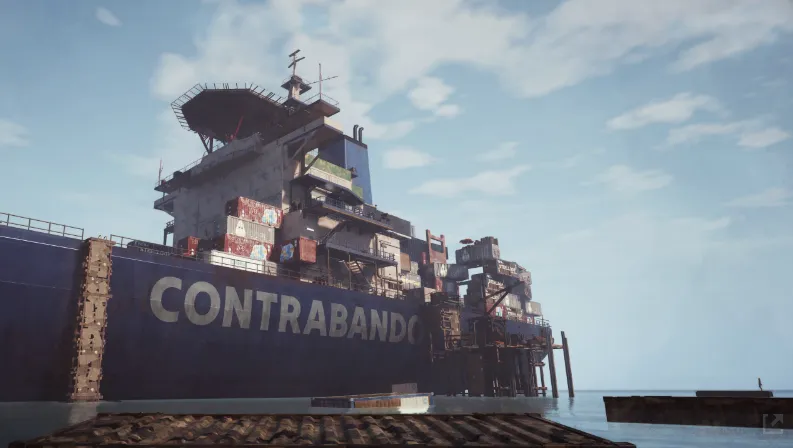 The Contrabando container ship viewed from the shore in pre-release footage
A survival loop built around container “blind boxes”
Shipping containers are the game's most distinctive resource system. Opening one is a calculated gamble because its cargo may be immediately useful, strangely specific, or apparently worthless. Instead of finding only neat stacks of wood and medicine, you may uncover commercial goods, appliances, tools, or even vehicles.
The interesting part is what happens next. 30 Days on Ship wants players to think like scavengers:
- Remove a battery from a vehicle and use the power elsewhere.
- Keep food in a working refrigerator rather than treating it as decoration.
- Break into sealed areas with the right cutting or demolition tool.
- Move heavy objects to create access routes or reinforce a shelter.
- Salvage fuel, components, and materials from items that cannot be used intact.
This gives loot a second question beyond “is the number bigger?” An object can be valuable because of what it does, what it contains, or where physics lets you place it.
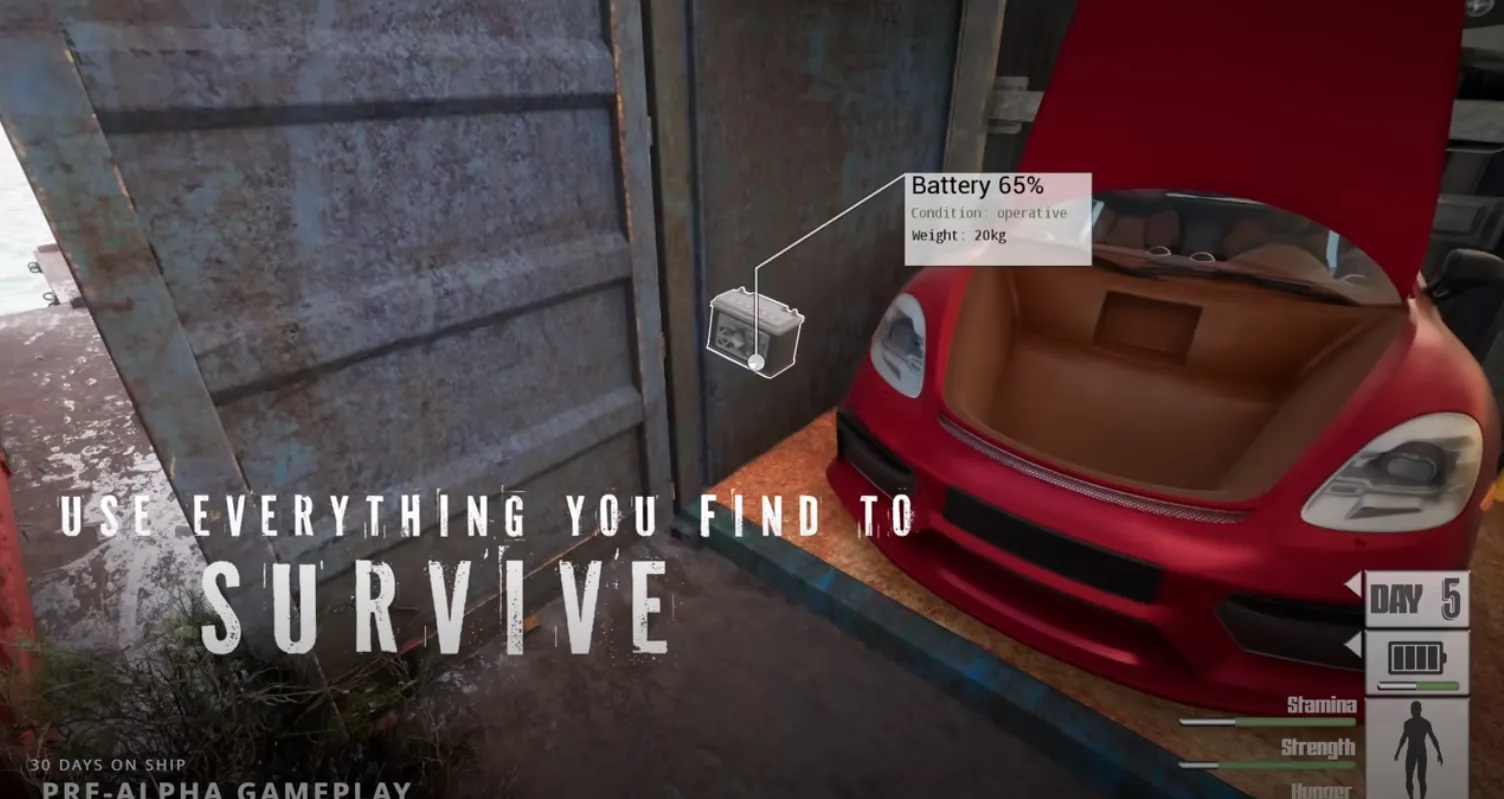 A car battery being removed for reuse in pre-alpha 30 Days on Ship footage
What you do during the 30 days
The core loop combines familiar survival systems with the unusual geometry of the ship.
Scavenge and plan
Each trip away from shelter costs daylight, stamina, and supplies. You search containers and ship compartments for food, water, tools, weapons, and components, then decide what is worth carrying home. Diving expands that search into the water, where submerged cargo comes with additional risk.
Build and repair
Salvaged materials feed workbenches, shelter improvements, storage, defensive positions, and access tools. Physics-based interaction is central to the pitch: objects can be dragged and repositioned, damaged routes can be repaired, and parts of the environment can be broken with the appropriate equipment.
Manage the survivor, not only the inventory
Hunger and thirst create the immediate pressure, while the full game's Steam description also emphasizes mental health. Isolation is supposed to be a system to manage, not merely a line in the story. A secure, supplied base therefore serves both practical and psychological needs.
Prepare for trouble
Storms can interrupt even a sensible plan. Wildlife threatens the ship and surrounding water, while pirate encounters add armed human opposition. Development updates have shown continuing work on enemy reactions, weak points, weapon upgrades, bows, melee status effects, vehicle controls, and combat feedback. Those details are still being tuned through testing, so older demo footage should not be treated as the final balance or presentation.
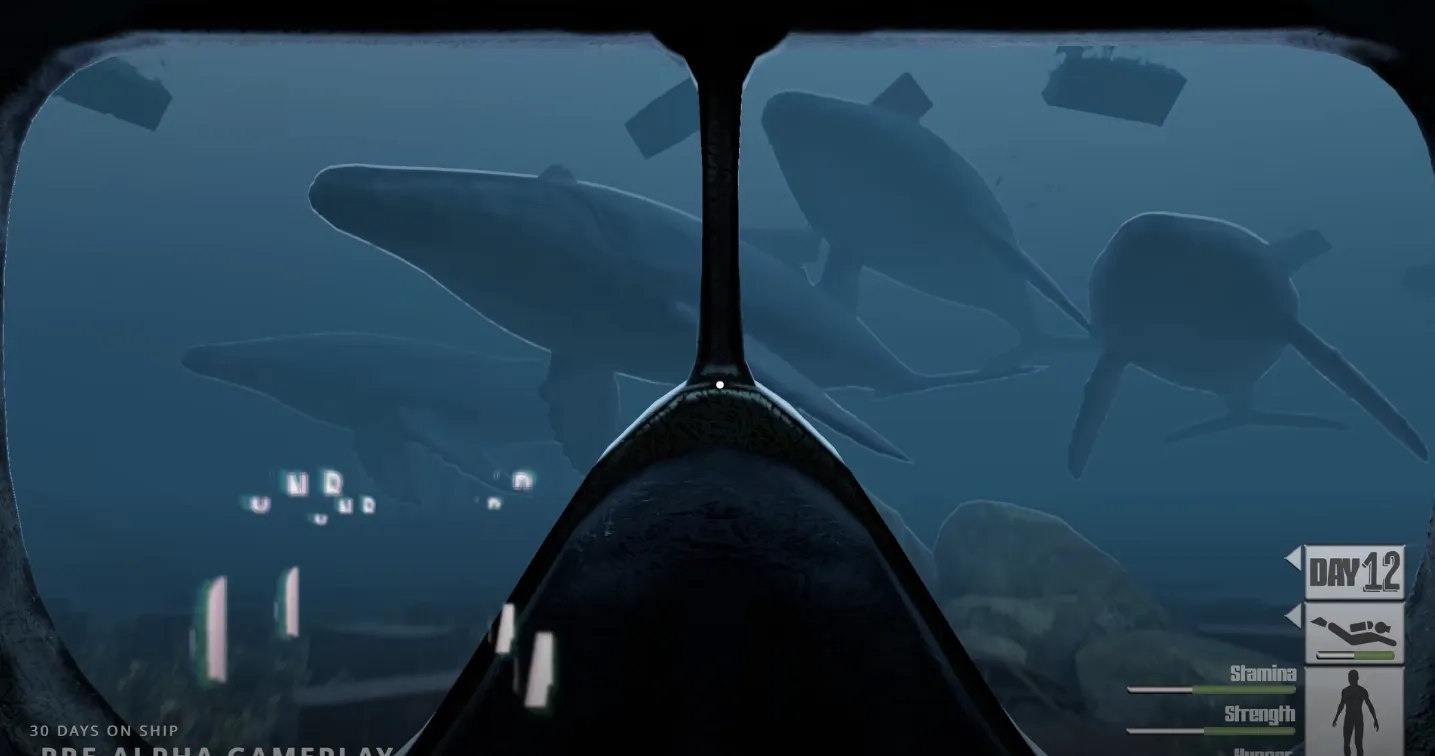 Underwater exploration and marine threats in pre-alpha 30 Days on Ship footage
Can you play 30 Days on Ship now?
Yes, but there is an important distinction.
The full 30-day game at Steam App 2800370 has not launched and still has no exact release date. On August 13, 2026, the developer released 30 Days On Ship: Castaway – The First Days, a separate free-to-play introduction that condenses the premise into three days.
The First Days is currently the easiest way to test the scavenging, hunger, thirst, building, combat, and ship exploration for yourself. It is a single-player sample rather than the complete 30-day campaign, and its Steam page should not be confused with the store page for the main game.
There was also an older public demo and several limited playtests. The developers have said that earlier demo builds no longer represent the current state of development. If a video shows a different interface, rougher performance, or mechanics missing from the free 2026 release, it may simply come from an obsolete build.
What is happening with co-op?
The main Steam page lists both single-player and online co-op, but the rollout is more nuanced than that label suggests. According to the developer's Early Access plan, the first Early Access version is intended to launch as a complete single-player experience. Co-op is planned for testing later during Early Access before becoming a wider free update.
That sequence makes sense for this design. Multiplayer could turn the ship into a busy division-of-labor sandbox: one player explores, another sorts supplies, another builds, and another prepares defenses. It also creates difficult technical problems around movable physics objects, vehicles, inventories, saves, and enemy synchronization. Until the developer announces a final release plan, it is safest to treat co-op as a confirmed direction rather than a guaranteed day-one feature.
PC system requirements
The following specifications are listed for the full game on Steam. They may change before release.
| Minimum | Recommended | |
|---|---|---|
| OS | Windows 10, 64-bit | Windows 11, 64-bit |
| CPU | Intel Core i5-9600K / AMD Ryzen 5 3600 | Intel Core i7-10700K / AMD Ryzen 7 3700X |
| Memory | 12 GB RAM | 32 GB RAM |
| Graphics | GTX 1660 Super 6 GB / RX 5600 XT 6 GB | RTX 3060 12 GB / RX 6700 XT 12 GB |
| DirectX | Version 11 | Version 12 |
| Storage | 35 GB | 35 GB |
| Target | About 30 FPS, low/medium, 1080p with upscaling | 60 FPS, medium/high, 1080p–1440p |
The recommended 32 GB of memory and 12 GB of VRAM are worth noticing. This is an ambitious, physics-heavy environment with a great deal of movable clutter, so players close to the minimum specification should try the free version before assuming how the finished game will run.
Why 30 Days on Ship stands out
30 Days on Ship does not need to reinvent hunger meters to feel different. Its identity comes from combining three good constraints:
- One memorable place. The wreck is a layered, physical space you gradually learn rather than a disposable map.
- Unpredictable cargo. Containers turn every supply run into a reveal and reward creative reuse instead of simple loot rarity.
- A visible finish line. Thirty days give the survival sandbox a destination. Every short-term decision can be measured against the question of whether it helps you reach rescue.
The concept is strong; the remaining question is execution. Combat feel, performance, AI behavior, co-op stability, and the depth of the crafting economy will decide whether the ship remains interesting for all 30 days. Madnetic Games has been revising those systems through demos, playtests, and frequent development updates, which makes the free three-day version particularly useful as a snapshot rather than a final verdict.
If the idea of turning a stranded cargo ship into a giant survival puzzle appeals to you, start with Castaway – The First Days on Steam, wishlist the full game, and use 30daysonship.com to follow future updates and feature changes without having to piece them together from old builds.